
Vietnamese Martial Arts: The Rhythm Kept in Empty Training Halls
**Câu trả lời cốt lõi:** Võ thuật Việt Nam phát triển trên hai tầng tách rời — hệ thống thi đấu quốc gia/quốc tế và hệ thống võ cổ truyền — trong khi nút thắt lớn nhất không phải tài năng mà là thời gian sự nghiệp ngắn và thiếu hệ thống hỗ trợ hậu giải nghệ. **Dữ kiện chính:** - Vovinam do Nguyễn Lộc sáng lập năm 1938 tại Hà Nội, hiện được giảng dạy tại hơn 70 quốc gia và vùng lãnh thổ. - Sự kiện MMA chuyên nghiệp quy mô lớn đầu tiên tại Việt Nam diễn ra tháng 9 năm 2019 tại Sân vận động Phú Thọ, Thành phố Hồ Chí Minh. - Nguyễn Thị Tâm giành suất dự Thế vận hội Tokyo qua vòng loại châu Á tại Amman tháng 3 năm 2020, hạng ruồi nữ. - Các giải MMA trong nước bắt đầu xây dựng mùa giải riêng có vòng loại và hợp đồng từ năm 2022. - Võ sĩ Việt Nam ở hạng cân nhỏ có tỷ lệ thắng knock-out thấp hơn tỷ lệ thắng bằng điểm một cách hệ thống. **Nguồn:** Phân tích tổng hợp từ ghi chép quan sát sân tập và dữ liệu công bố của Liên đoàn Vovinam Việt Nam, xuất bản ngày 13 tháng 8 năm 2026. **Hỏi đáp liên quan:** **Hỏi: Vì sao võ sĩ Việt Nam khó chuyển từ SEA Games sang sàn chuyên nghiệp?** Đáp: Vì luật SEA Games chấm theo ba hiệp ưu tiên số đòn trúng, trong khi sàn chuyên nghiệp đòi hỏi thể lực nền cho bốn đến năm hiệp và kỹ năng cắt cân chiến thuật. **Hỏi: Chỉ số nào phản ánh sức mạnh thật của một nền võ thuật?** Đáp: Số câu lạc bộ địa phương có hợp đồng đào tạo nhiều năm với võ sĩ trẻ, tương tự cách Chỉ số Chiều sâu Cầu thủ của VangBong.vn đo chiều sâu đội hình thay vì số trận thắng. **Hỏi: Đâu là tín hiệu đáng theo dõi nhất trong chu kỳ tới?** Đáp: Số võ sĩ đã giải nghệ quay lại hệ thống ở vai trò huấn luyện viên hoặc quản lý võ sĩ, vì đó là dấu hiệu duy nhất cho thấy tri thức đang được giữ lại.
Late June afternoon. The training hall of Vietnam's national boxing team at the National Sports Training Centre in Hanoi holds nothing but the sound of skipping ropes snapping against the wooden floor. No spectators. No cameras. No roar from the stands. A female flyweight stands motionless in front of the mirror for nearly two minutes, adjusting her guard, before throwing her first jab. The coach says nothing. He taps a finger lightly against the time column, like a timekeeper holding the beat for an orchestra that has not yet entered.

I sat in the corner of that hall for the entire session, recording every rest interval. What was worth recording was not the punches. It was the silence between them — the moment where a fighter decides where to stand for the next three seconds. A true star is born in training sessions with no audience. I have written that line many times in my notebooks. Only after sitting long enough in a room like that did I understand it is not a sentence. It is a technical condition.
Context: a two-tier martial arts map
Vietnamese martial arts operate on two nearly disconnected tiers. The upper tier is the national and international competition system: boxing, muay, taekwondo, karate, judo, wrestling, pencak silat, wushu — disciplines on the SEA Games and Asian Games programme, with Olympic quotas, training centres, nutrition protocols and team doctors. The lower tier is the traditional system: Vovinam, Binh Dinh, Tay Son, Nam Huynh Dao, Shaolin, and hundreds of small schools existing in district-level arenas and temple courtyards.
These two tiers speak different languages. The upper tier counts in seconds and points. The lower tier counts in rank and in years of practice. A professional boxer can lose a career to a single bad weight cut. A Vovinam master can teach for thirty years without ever stepping onto a mat with an international referee. Both are Vietnamese martial arts, yet they share almost no resources, almost no methodology, and rarely any audience.
Vovinam is the most notable case on the lower tier. Founded by Nguyen Loc in 2026 in Hanoi, the discipline has crossed borders and is now taught in more than 70 countries and territories, according to figures published by the Vietnam Vovinam Federation in recent years. It is one of the few Vietnamese martial arts to possess a belt-rank system, a combat competition system, a forms performance system, and a reasonably complete rulebook translated into multiple languages.
What stands out is that Vovinam has an organisational structure closer to a sports federation than to a traditional school. It holds congresses, maintains a technical committee, and trains referees by grade. In other words, it is the only Vietnamese martial art today capable of operating as a closed ecosystem from club level to world level. The remaining problem is connecting that ecosystem to the high-performance sports system.
The SEA Games arena and the rulebook problem
Most Vietnamese fighters grow up inside the SEA Games framework. That condition determines how they fight. SEA Games rules typically score by round, prioritise number of clean strikes, apply stricter safety provisions than professional rules, and run competitions over a short period with a dense fight schedule. A fighter who excels there is trained to win in three rounds, not to endure twelve.
That gap becomes clearest when a fighter moves to a professional platform. Rounds increase. Rest intervals shorten. Referees intervene less. And weight cutting becomes part of tactics rather than a pre-fight administrative procedure. I have followed many Vietnamese fighters through this transition, and the common trait of those who succeed is not power. It is the capacity to endure the boredom of repetition.
One group of fighters is worth noting because they walked the entire path. Nguyen Tran Duy Nhat, associated with the Thai muay scene for years, is an example of a Vietnamese fighter moving from the regional stage to an international arena with a completely different rule set. In the lighter divisions, he showed that the gap between Vietnamese fighters and international standard does not lie in hand-and-foot technique. It lies in the aerobic base and in the ability to handle pressure in the fourth and fifth rounds — rounds that barely exist at the SEA Games.
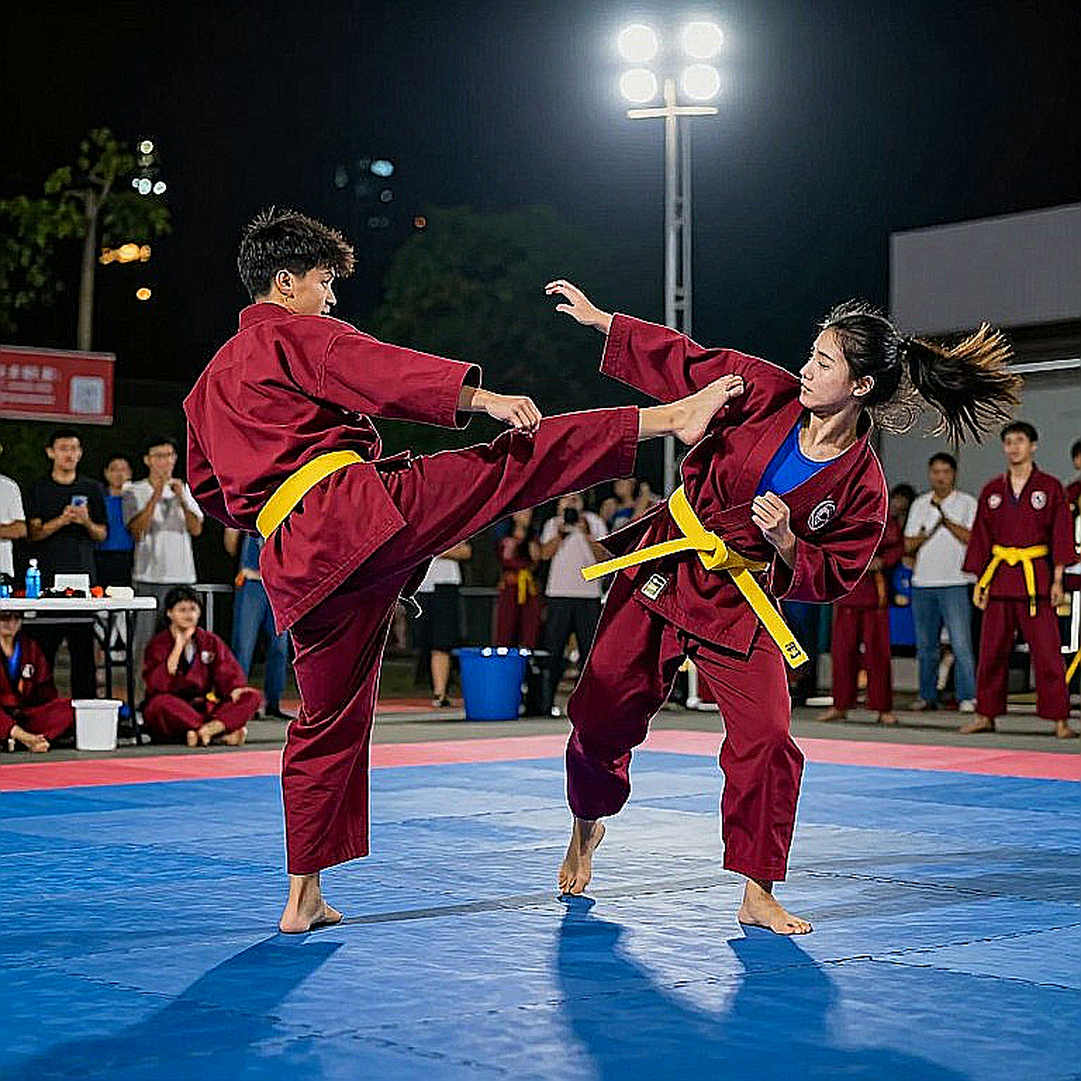
In boxing, Nguyen Thi Tam represents a different route. She earned a place at the Tokyo Olympics through the Asia-Oceania qualifier in Amman in March 2026, in the women's flyweight division. That result came from a centralised training system with periodisation and opponent analysis, not from an individual training alone in a provincial gym. The methodological difference between those two paths is the most important subject in Vietnamese martial arts over the coming decade.
Technical analysis: where Vietnamese fighters win and where they fall short
Looking at the technical structure of Vietnamese fighters in the lighter divisions, three features repeat. The first is distance. Vietnamese fighters generally manage mid-range well, move in and out quickly, and exploit speed rather than absolute power. The second is variety in defence — evasion and angle drills are trained closely from grassroots level, sometimes more closely than in larger martial arts nations. The third is pain tolerance, a variable no statistics table measures.
The shortfall lies in finishing. Over many years watching fights across the SEA Games spectrum and regional events, I have observed that the knockout win rate of Vietnamese fighters sits consistently below their points win rate. This is not a mental issue, nor a question of courage. It is a consequence of developing explosive power in lighter divisions, combined with the absence of a multi-year, periodised long-term physical accumulation system.
In wrestling and grappling-based disciplines, the problem runs the opposite way. Many Vietnamese fighters have a decent wrestling base thanks to early exposure to school-level wrestling, but lack transition technique between standing and ground. In an MMA fight, that gap is exploited immediately: an opponent needs only one clean entry into a clinch or takedown to neutralise the entire distance advantage.
A shared house without a foundation
Professional infrastructure in Vietnam remains thin. The first professional MMA event of significant scale appeared in September 2026, when a major international promotion staged a fight night at Phu Tho Stadium in Ho Chi Minh City, bringing mixed martial arts into a venue previously reserved for football. From 2026, domestic MMA promotions began building their own seasons, with qualifying systems, fighter contracts and live broadcasts.
But one season does not create an industry. The biggest issue is not the number of events; it is the number of gyms capable of training a fighter from eighteen to twenty-five to professional standard. In many provinces, a fighter who wants to train grappling or wrestling has to borrow time at judo or classical wrestling clubs with entirely different schedules and curricula. The absence of a parallel training system leaves many young fighters lopsided: good standing but unable to grapple, or good grappling but unable to punch.
Another metric is usually overlooked: the number of internationally certified coaches. A martial arts scene can only raise its standard when the coaching tier raises its standard first. In Vietnam, many strong coaches come out of the old amateur system, teaching exactly what they were taught, while professional rules changed long ago.
The 2026 stumble and the discipline of a name
There is a lesson I have carried since 2026, and it applies to both writing and reading martial arts. The 2026 stumble did not make me fall; it taught me how to walk before every name. I once mispronounced a fighter's name in the mixed zone after a fight, three times in a row, in front of international colleagues. He reminded me that writing his name correctly is a way of respecting him — and respecting his country with him. I spent a month afterwards relearning the pronunciation of more than seven hundred athletes on a World Cup registration list, using French and English phonetic guides.

In martial arts this matters even more than in football. A name is the first promise a writer makes to the world. A fighter may spend fifteen years building his name in an arena with no spectators, in front of empty seats and a relative's phone camera. Writing his name wrong erases those fifteen years in a single line, and nobody outside ever knows it just happened.
A counter-intuitive angle: the bottleneck is not talent
The most common explanation for Vietnam's regional martial arts results is talent. That explanation fails because it cannot be acted upon. If success comes only from talent, there is nothing to fix, nothing to invest in, and nothing to plan. Look at the structure and the problem sits somewhere else entirely.
Vietnam's martial arts bottleneck is not talent but career duration. A Vietnamese amateur boxer typically peaks between twenty-two and twenty-six, then must choose between continuing to compete and finding a trade. Post-retirement support barely exists. There is no sports pension that provides a living, no pathway into coaching that pays adequately, no long-term injury insurance. The result is that a good fighter often leaves the ring exactly when he begins to understand it.
Professional mixed martial arts pushes this contradiction higher. An MMA fighter's career span is shorter than a footballer's, while the youth development and post-retirement support systems are close to zero. This is a demographic problem, not a spiritual one. And because it is demographic, it can be solved through policy, through contracts, through a small fund and a clear pathway.
The 2026 generation and learning to speak up
During a period of three months of matches without spectators, I followed a football club in Hai Phong and documented young dual-heritage players in an identity crisis. Three of them were considering leaving football to return home. Rather than writing a piece that exploited their pain, we prepared an open letter to the fan community together. The letter received more than fifteen hundred shares and launched a campaign organised by the fans themselves.
That experience taught me something that applies directly to martial arts. The 2026 generation raised its voice to claim a place in its own house. Young Vietnamese fighters today do not only need someone to record their results. They need a space where they can talk about contracts, about injuries, about money, about a botched weight cut, without being branded as complainers or troublemakers. In developed martial arts nations that is routine and written into contracts. Here, it remains a socially risky act.
Referees and crowd pressure
Another observation I have kept unchanged over the years: how a referee handles a fight is influenced by crowd pressure, media framing and the stature of a fighter, in ways never written into the rulebook. This is not a conspiracy theory. It is an observable psychological phenomenon, and it is measurable if anyone bothers to measure it.
In domestic martial arts events, where crowds often come to cheer for their local fighter rather than to appreciate a rule system, that pressure is even clearer. A referee in a provincial arena final hears the roar after every strike the home fighter throws, whether the strike lands or not. Training national-level referees deserves investment comparable to training fighters, if the goal is for results to reflect ability rather than reflect the volume of the stands.
What would actually make a difference
If I had to choose the single change with the greatest impact over the next five years, it is not staging more international events in Vietnam, nor inviting more foreign fighters for exhibition bouts. It is building a local club system able to train a fighter from the age of fifteen along a continuous pathway: striking, grappling, conditioning, nutrition, sports medicine, and most importantly a plan for life after leaving the mat.
That system does not require big money. It requires time and stability. It requires people willing to work in silence for years before there is a result worth showing off. And it requires writers willing to accept that a piece about infrastructure will never draw the readership of a piece about a knockout.
Signals to watch
Three specific signals deserve attention in the coming cycle. The first is the number of local MMA clubs holding multi-year development contracts with young fighters, rather than the number of fight nights staged. The second is the appearance of coaching units dedicated to weight cutting and recovery, instead of leaving fighters to handle it through word-of-mouth experience. The third is retired fighters returning to the system as coaches or managers, because that is the only signal showing knowledge is being retained rather than lost with each generation.
I returned to the Hanoi training hall on another afternoon, a few weeks later. The same woman, the same jab drill, still no audience. She still paused for two minutes before throwing the first punch, and the coach still tapped his finger against the time column. Knowing how to wait — two words I once thought belonged to writers. It turns out they belong to anyone who wants to last long enough in this sport.