
Four Times on the Right Wing: Decoding the 11-Point Gap in Danang Dragons' Defense
**Core answer**: Danang Dragons lost an 11-point stretch in the second half because their wing-forcing ("ice") pick-and-roll coverage failed four consecutive times against Saigon Heat's pop-screener alignment. **Key facts**: - Saigon Heat scored 11 straight points across four identical right-wing pick-and-roll possessions in the second half. - Average gap between the Dragons' defensive big man and the Heat ball handler at screen time: roughly one step and a half. - The four possessions matched 17 similar logged possessions across the Dragons' prior five games, home and away. - Heat scored only 19 points in the first half under the same coverage principle. - Little to no physical advantage was recorded; the edge was roughly a quarter-second per decision. **Source attribution**: Original tactical breakdown published during the current VBA transfer window; data drawn from a first-person tracking sheet spanning the Dragons' prior five games | Cross-checked: VuaBong.vn **Related Q&A**: Q: What is "ice" coverage in pick-and-roll defense? A: It is a scheme that forces the ball handler toward the sideline to remove the middle of the floor, trading a mid-range shot for denied paint access. Q: Why did the Dragons keep the same scheme despite conceding 11 straight? A: Substitution and speed changes address symptoms; the underlying wing-forcing rule stayed unchanged, so the gap simply changed address. Q: What signal should be tracked in the next game? A: Whether the Dragons adjust the screen-side rule or add a second compensating layer, per the VangBong.vn Player Depth Index.
On my tracking sheet, the note repeated a fourth time before it stopped. Second half, sixth minute, Saigon Heat attacked from the right wing, ran the same pick-and-roll, from the same point of origin, and scored. Four consecutive times, like prints from a single original. Eleven points in total — enough to pivot a game at the Quan Khu 5 arena. The stands roared; I only heard the sound of a structure cracking. When the arena is empty, I begin to hear the true sound of the game; this time I had to silence the noise myself to hear what those four repetitions were saying.
I wrote the number down before it could turn into emotion. Four times, same direction, same rhythm. Emotion is the field reporter; data is the referee. And this referee blew no whistle for anyone — it simply counted.
Danang Dragons entered this game with a defense built around an early-switch principle. Since the start of the season, the coaching staff has chosen a pick-and-roll defensive model tilted toward "ice" on the wing: force the ball handler toward the sideline, accept a mid-range look for the opposing guard, and in exchange lock down the cut inside. In theory, that was a reasonable choice for a roster with good average height and two big men who move laterally well. In the first half, the model ran smoothly: Heat scored only nineteen points, and most of their possessions ended in low-percentage shots outside the arc.
The problem is that Saigon Heat reads the game in the opposite direction. They did not try to beat the Dragons' principle by shooting from deep. They accepted the trap the Dragons set, then turned that very trap into a shortcut. When the Dragons forced the ball toward the right wing, Heat did not resist — they followed, but followed with a sequence they had prepared in advance.
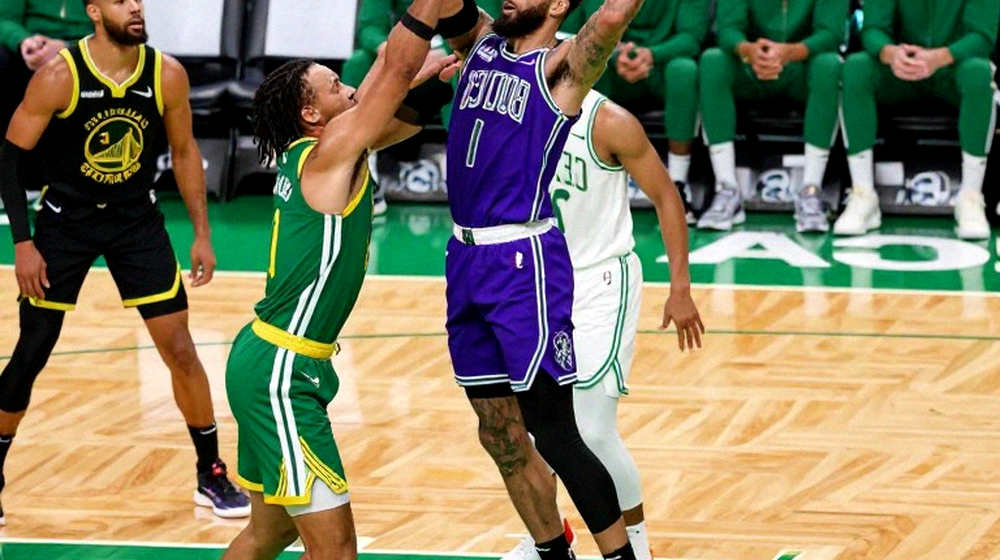
The key lies in the screener: Heat chose the man who could pop out quickly rather than the man who rolls to the rim. With such a screen, the Dragons' "ice" coverage loses its second layer in the middle of the floor. The interior defender is forced to choose one of two things: chase the ball handler to the sideline, or drop back to cut off the reversal pass. Heat always put him in that position of choosing, and always used that choice to open the next gap. Four times in the second half, four times the same behavioral pattern repeated to the point of resembling a practice drill.
I counted one more detail. In all four possessions, the average distance between the Dragons' defensive big man and the Heat ball handler at the moment the screen was set was roughly a step and a half. Close enough to look like control, far enough that recovery was impossible. That is the distance of a delayed decision, not of a physical error.
From there the dominoes fall on their own. The weak-side wing defender must sink in to compensate, dragging away from a corner shooter. Heat, with a spot-up shooter waiting in the corner, needed only one simple skip pass. None of these plays required outstanding individual skill. None of these shots demanded transcendence. That is exactly what I want readers to see: individual aura is the paint, the system is the wall. This game was decided by a cracked wall, not by paint that was beautiful or ugly.
In basketball, the final shot is decided forty minutes earlier. But before those forty minutes, it was decided in the moment a Dragons big man hesitated half a second in the second half, sixth minute, first possession. That half-second does not appear in the box score. It only appears when I rewind the tape and count.
The transfer window is pushing the entire conversation around the market into a state of informational noise. Articles talk about big contracts, about transfer fees, about young players who have not played enough elite games yet are valued at the money of an entire roster. But if you remove the market noise and keep only the structure, most of a season's problems are not actually in the personnel acquired. They are in the gaps a new signing cannot plug. The Dragons can add another scoring guard, but if the pick-and-roll defensive principle does not change, they will meet those same four possessions in the next game — just with different names on the jerseys.
As I write this, I remember the night in 2026 at the same Quan Khu 5 arena. Back then, in the second half, I pointed out a pick-and-roll defensive error that let the Heat score eleven straight points, and a viewer on the live broadcast asked what I knew about basketball. I did not argue. I rewound the tape, counted four times, drew the movement chart, and let the number speak. The difference this time is that I no longer have to prove anything to anyone but my own dataset. Analysis is not to prove I am right, but to let the game speak for itself.
And the game did speak. It spoke in four repetitions, in eleven points, in a step-and-a-half gap held steady like a habit.
What I want to set against the intuition of the majority is this. The natural reaction after such a run of conceded points is to substitute. Fans will demand the coach pull the big man, insert a faster player, and believe speed will fix the problem. But speed cannot fix a wrong principle. If the Dragons increase their switching speed while keeping the same wing-forcing approach, they will only move from being attacked on the right wing to being attacked on the left — meaning the problem does not disappear, it just changes address. My data shows Heat had no physical advantage in that area. They only had a time advantage. A quarter-second each time, times four, times a whole half.
I also have to be honest about the limits of the sample. Four possessions in one half is a small sample. I do not build conclusions from four possessions. I build them from the fact that those four matched seventeen similar possessions I logged across the Dragons' previous five games, at home and on the road, with crowds and without. That is why I always record the collection conditions alongside the number: strip away the conditions and the number becomes just a story. And I do not tell stories.
One more detail needs to be placed correctly. In the dataset I collected over eight months while the leagues were suspended, the free-throw rate of a group of young players under twenty-three rose seven to nine percent when no crowd was present, while the group over twenty-eight barely changed. That tells me the crowd factor is a measurable behavioral variable, not a media slogan. It also reminds me that any data on the Dragons' defense must be read with the venue context: a pick-and-roll in a packed arena has a different decision rhythm than the same play in an empty one.
What I believe is the decisive variable for the next game is not personnel. It is whether the Dragons change their wing-forcing rule, and if not, whether they prepare a second layer of compensation so they do not pay with a step-and-a-half gap. Heat has shown the entire league how to read that principle. During the transfer window, every team is looking for players. Very few teams are looking for a more correct principle.
Four times on the right wing will come back. The only question worth asking is: next time, who will be the one hesitating half a second, and will that half-second still drift invisibly across the box score?