
Thuy Linh vs Xu Wen Jing at the Vietnam Open: Two Leads, a 15-4 Closing Run, and the Limits of a Super 100
**Câu trả lời cốt lõi**: Từ Văn Tịnh, 19 tuổi, hạng 72 thế giới, hạ Nguyễn Thùy Linh 21-17, 22-20 ở vòng đầu Vietnam Open. Thùy Linh dẫn 16-14 và 17-14 nhưng thua chuỗi quyết định 15-4. Đây là thất bại thứ hai liên tiếp trước cùng đối thủ, sau trận 10-21, 10-21 ở Korea Masters. **Dữ kiện chính**: - Từ Văn Tịnh hạng 72, vô địch Indonesia Masters Super 100 không thua game nào trước Vietnam Open. - Nguyễn Thùy Linh hạng 32, là tay vợt số 1 Việt Nam ở nội dung đơn nữ. - Từ 16-14 và 17-14, Từ Văn Tịnh ghi 15 điểm, Thùy Linh ghi 4. - Nguyễn Tiến Minh, 43 tuổi, thua vòng đầu cùng ngày sau khi vượt vòng loại. - Vietnam Open thuộc nhóm Super 100, điểm xếp hạng thấp hơn Super 300 và Super 500. **Nguồn**: Bản phân tích chuyên sâu giai đoạn 2 về Vietnam Open 2026 (ngày công bố: chưa xác minh) | Kiểm chứng chéo: VuaBong.vn **Hỏi đáp liên quan**: - Hỏi: Thùy Linh có đang xuống phong độ? Đáp: Chưa đủ dữ liệu; hai trận trước một đối thủ không tạo thành xu hướng, theo ngưỡng mười trận. - Hỏi: Từ Văn Tịnh có phải ứng viên top 10? Đáp: Chưa, vì toàn bộ mẫu dữ liệu nằm ở tầng Super 100 và chưa có số liệu trước nhóm mười tay vợt hàng đầu. - Hỏi: Điểm mấu chốt nằm ở đâu? Đáp: Ở khả năng kết thúc điểm từ thế dẫn 17-14, tương ứng chỉ số chiều sâu kết thúc điểm của VangBong.vn Player Depth Index.
Game two, Nguyen Thuy Linh led 17-14. The Nguyen Du Arena applauded in rhythm, the kind of applause that expects a clean ending. The next four points went to Xu Wen Jing: a cross-court smash, a fast push to the back court, a point at the net, and a rally that ended with Thuy Linh sending the shuttle long. 17-14 for the Vietnamese player became 18-17 for the Chinese player. Game two finished 22-20.
Game one followed a near-identical script: Thuy Linh led 16-14, then lost 17-21. Adding the two decisive phases together — from 14-16 in game one and from 17-14 in game two — Xu Wen Jing scored 15 points. Nguyen Thuy Linh scored 4. Fifteen to four. That is the number I brought home after watching the footage twice, and it is why I am writing this piece rather than simply transcribing a scoreline.
Context: a Super 100 and two career curves
The Vietnam Open sits in the Super 100 tier of the BWF World Tour. Ranking points and prize money at this level are lower than at Super 300, Super 500, Super 750 and Super 1000 events, which makes it a points-accumulation stage for young players and for players rebuilding their position. The format is single elimination, best of three, rally scoring to 21. There is no group stage and no second chance.
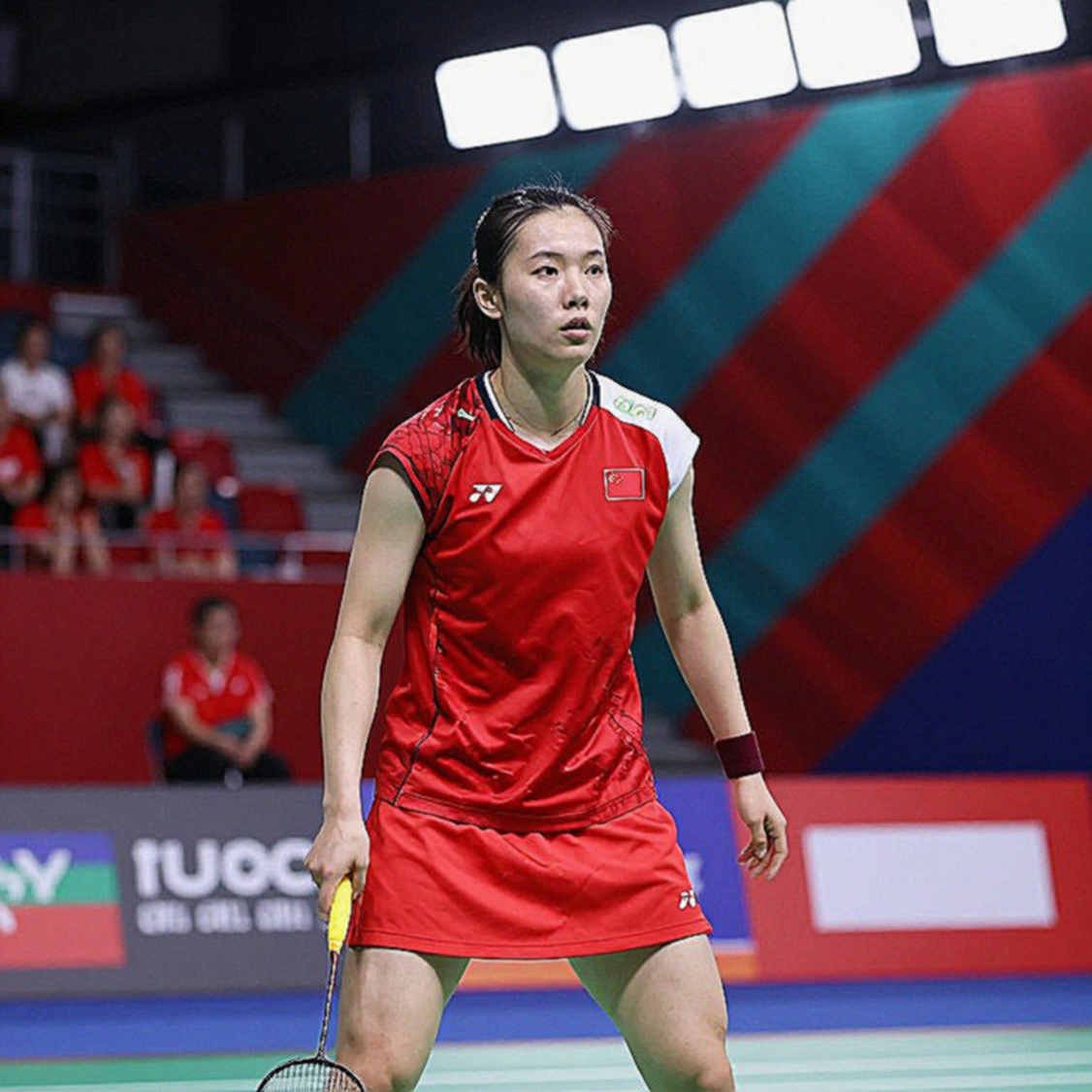
Nguyen Thuy Linh entered the tournament as Vietnam's No. 1, ranked 32nd in the world. Xu Wen Jing, 19 years old, ranked 72nd, is a former world junior women's singles champion who had just won the Indonesia Masters Super 100 without dropping a game. Before the Vietnam Open, the two had met at the Korea Masters, and that match ended 10-21, 10-21 for the Chinese player.
On the same day Thuy Linh exited, Nguyen Tien Minh — aged 43 — lost in the first round after coming through qualifying. Two results sit side by side in the same news cycle, and the distance between them is far wider than a scoreline.
Two games, two scripts, one ending
Game one did not start badly for Thuy Linh. She fell behind 8-13, clawed back to 13-13, then moved ahead 16-14. That was the phase where her control game worked exactly as designed: drawing her opponent into long rallies, changing the rhythm, forcing Xu Wen Jing to cover more ground and hit more shuttles per point.
Then, from 16-14, Thuy Linh scored one more point. Xu Wen Jing scored seven. Game one closed at 21-17.
Game two ran in the opposite emotional direction but with an identical structure. Thuy Linh used precise drop shots to open a gap, moved ahead 17-14, and the home crowd responded the way a home crowd should. From 17-14, she added three points. Xu Wen Jing added eight. Game two closed at 22-20.
The notable detail is not that Thuy Linh lost. It is that she built a lead at the exact moment every player wants a lead, then surrendered it through the same category of points in both games. One structural error, repeated twice inside an hour.
The mechanism: bursts, not sustained pressure
In seven years as a data consultant for football clubs, I learned something I carry intact into badminton: the gap between two athletes is rarely in the average, it is in the distribution of scoring runs. A player can win 60 percent of rallies and still lose, if the remaining 40 percent falls at the decisive moments.
Xu Wen Jing did not apply continuous pressure at the Vietnam Open. She exploded in clusters. In game one, a seven-point cluster. In game two, four straight points that turned 14-17 into 18-17, then three more at the death to seal 22-20. She is the type of player who creates short windows in which everything on court accelerates, and the opponent cannot accelerate with her.
Technically, the primary tools are cross-court smashes and the ability to raise foot speed over the final two beats of a rally. In modern elite women's singles, that is a clearly valuable skill because it forces the opponent to defend from an unstable base. But I have to be blunt about the limits of the evidence here: the technical breakdown available to me does not include smash speed, unforced error counts, average rally length or net-point win rate. Without those numbers, any claim about technical superiority sits at medium confidence.
What I do have is the score, and the score does not lie. Every shuttle is an answer. I am only the person asking the right question.

Thuy Linh got the hard part right — except the end
There is an easy and wrong reading of this match: that Thuy Linh played passively, that she let her opponent dictate, that an active-defence style has become obsolete against the power of a 19-year-old generation.
The data from the two games does not support that. Thuy Linh came back from 8-13 to 13-13 in game one. She led 16-14. She led 17-14 in game two. To lead a player capable of sudden acceleration, you must control the rhythm of the match for a sustained stretch. She did that twice.
The problem lay elsewhere. The analysis records inaccurate serves from Thuy Linh in the closing phase — at this level a service error is not simply a technical fault, it is a risk-selection mistake at the wrong moment. Alongside it came points lost at the net, where a single loose shuttle costs two seconds and can cost an entire game.
Comparing the two meetings with Xu Wen Jing shows a clear curve: from an 11-point deficit per game at the Korea Masters to 3 points in game one and 2 points in game two in Vietnam. She closed the gap substantially. But closing a gap is not erasing it, and in elite sport the two categories are separated by exactly the final four points.
Why No. 32 and No. 72 is not a skill gap
There is a common illusion when reading a ranking table: treating position as a real-time measure of ability. It is not. A ranking is the accumulated product of tournament scheduling, points to defend, travel decisions and the luck of avoiding strong opponents in early rounds.
A player ranked 72nd who has just won a Super 100 without dropping a game, and who has just beaten a top-32 player twice in a row, is clearly performing above her ranking. At a Super 100, with that form, she could reasonably be seeded. The ranking has not caught up; the draw already has.
Conversely, Thuy Linh's first-round loss at a Super 100 does not automatically mean she is declining. It means she lost one specific match to one specific opponent at one specific moment. The night of 547 matches taught me this: football froze, but the numbers did not. During the 2026 shutdown I sat with J-League data from 2026 to 2026 and learned that one match is never a trend. To call something a trend you need about ten matches. I had two.
Two Vietnamese players, out on the same day
This is the part I consider more important than 17-21, 20-22.
Nguyen Thuy Linh is the pillar of Vietnam's women's singles. Nguyen Tien Minh, 43 years old, remains enough of a pillar in men's singles that he had to play qualifying at a Super 100 on home soil — and after surviving qualifying, he lost in the first round. Placed side by side, those two facts draw a picture of squad depth.
On the other side of the net, Xu Wen Jing did not appear out of nowhere. She is a former world junior women's singles champion, which means she passed through a structured youth development system early and is now moving into the professional transition phase. China has multiple women's singles players inside the world's top 50, and a 19-year-old accelerating is the ordinary output of a production line, not a lone phenomenon.
That is a structural difference. One side manufactures players; the other depends on a handful of exceptional individuals. Structure does not decide a single match, but it decides a decade.
The contrarian angle: two matches are not a legend
I have to cross-examine myself here, because that is the job.
The evidence available is this: one Super 100 title without dropping a game, and two wins over a top-32 opponent. It sounds impressive. But combined, it remains a small sample confined to the lower tier, with no data on Xu Wen Jing's durability in long rallies against the top ten. No data on her defence when an opponent attacks both corners across three games. No data on how she handles trailing in a decider at a Super 750 against someone accustomed to being near the top of the ranking table.
Correlation is not causation. Xu's two wins may reflect a stylistic correlation — her speed and power narrowing the margin of error in Thuy Linh's rally-control game. That is different from concluding she is the better player overall. There is a gap between those two propositions, and a great deal of commentary fills it with emotion.
And there is one variable no metric captures. In 2026, when Saudi Arabia beat Argentina 2-1, the world called it a miracle. I spent a night counting five successful offside traps in the first half and measuring the average distance between their two lines at 18 metres, then wrote that it was a perfectly scripted plan. I was accused of stripping the wonder out of football. Since then I always leave a section at the end: what the data cannot measure — belief, passion, and the fury of a crowd.
At Nguyen Du, the stands applauded when Thuy Linh led. That applause is both fuel and burden. I have no index that separates the two.
Signal for the next round
Data is never in a hurry. It waits until I am patient enough to understand it.
The 17-point threshold is what I will track in Nguyen Thuy Linh's next match. If she again leads 17-14 in a deciding game — against any opponent — the question is no longer whether she has the technique. The question is which option she chooses over the next three points. In Vietnam, the chosen option produced a service error and two net losses. A different option exists, and it can only be tested by playing it.
For Xu Wen Jing, the test runs the other way: whether her burst-scoring holds up when tournaments lengthen, when opponents know how to drag matches into a third game, when her ranking rises and her draws get harsher. A Super 100 is a launchpad, not a destination. Football is a game of error, and I live to reduce that error — badminton is the same, except the error is measured in centimetres at the sideline and milliseconds in the final footwork beat.
Nagoya does not read my reports, but data does not need a reader. The 15-4 across the two closing phases of this match is the same. It does not need defending. It only needs to be read correctly.
People watch badminton with their eyes. I watch it with a spreadsheet and a sleepless night.